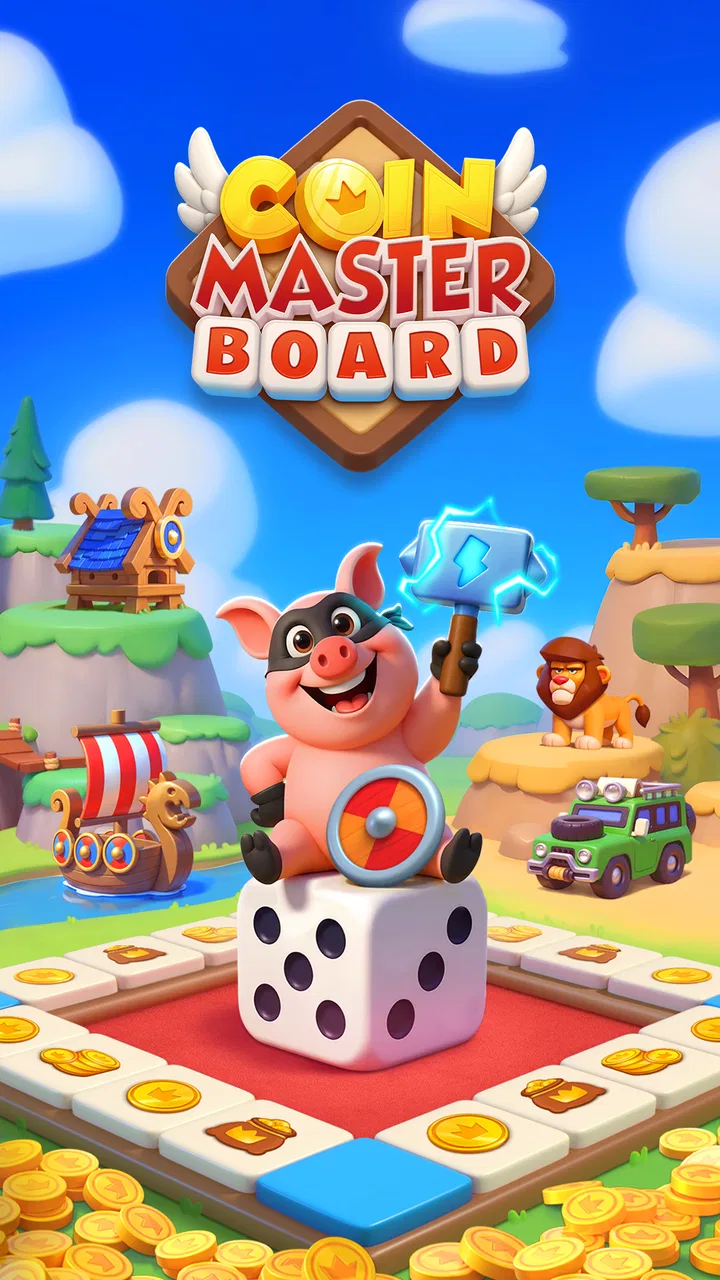
Coin Master - Board Adventure
- 4.7
- Rating
- 5.00M
- Installs
- Free
- Price

 Analysis by App-foxy
I spent time with Coin Master - Board Adventure as a light, casual game rather than treating it like a traditional board game. Its main appeal is the simple loop of rolling, collecting, improving a village, and checking how your score compares with friends. That makes it easy to understand quickly, but the experience is more dependent on chance and repeated short sessions than players who prefer deep strategy may expect.
Developed by Moon Active, this free game is aimed at Everyone and runs on Android devices using version 6.0 or later. It has reached over 500 thousand installs and holds a 4.8 average from around 6 thousand ratings, which suggests that its quick, social format has found a receptive audience. I can see why: it is approachable, colorful, and built around actions that take very little time to learn.
How the game feels to use in everyday play
I find the game easiest to enjoy when I treat each visit as a small, self-contained check-in rather than a task I need to finish. That approach helps me focus on one goal and avoid tapping through prompts on autopilot. Next, I’ll look at how the dice-and-village loop shapes those brief sessions, including where its simplicity gives way to chance.
You May Also Like

 Blood Strike: 2.5 Anniversary
Blood Strike’s Loadouts Turn Every Drop Into a Tactical Gamble
A close look at Blood Strike’s custom loadouts: how fast access to signature weapons reshapes its battle royale rhythm, rewards preparation, and narrows the gap between fights.

 Pandora - Music & Podcasts
Pandora’s Music Is Easy to Start, but Harder to Recover
Pandora’s strength is its low-effort path from a seed to a station. Its weak spot is how much confidence it asks you to place in connection, setup, and quiet recovery.

 8 Ball Pool
 Is Built on Rivalries, Rematches, and Routine
A close look at the rivalries, rematches, shared routines, and unanswered safety questions that turn a quick pool match into a persistent mobile community.

 Samsung Music
’s Quiet Strength Is Playing What You Already Own
Its reach comes less from spectacle than from dependable access to a personal library. That simplicity is both the app’s strongest retention engine and its ceiling.

 AccuWeather: Weather Radar
AccuWeather Review: A Quick, Clear Forecast for Everyday Decisions
For everyday plans, the best forecast is the one you can understand quickly. AccuWeather makes rain timing, radar, and local conditions easy to act on, with a few trade-offs.

 Hill Climb Racing
Why Hill Climb Racing Still Turns Crashes Into One More Run
A tiny car, a bumpy hill and one more upgrade: Hill Climb Racing keeps resurfacing because its simple chaos makes every near-miss feel personal.
More From Our News Desk



Readability and navigation are strongest when you want a quick session
The opening experience is easy to follow. The central action is obvious, and the game keeps the focus on the next roll or the next village improvement instead of asking me to learn a complicated ruleset. I never felt that I needed a long tutorial before understanding the basic purpose of a session.
That simplicity is especially useful on a small phone screen. I can open the game during a short break, see the available action, and make progress without setting aside a large block of time. The visual presentation is busy, as you would expect from a game built around rewards, buildings, and social competition, but the main path remains fairly clear because the important action is kept visually prominent.
Navigation is less comfortable when several reward prompts or event-style distractions compete for attention. A new player may tap through screens quickly and later realize that a resource or opportunity has been used without much thought. My practical advice is to slow down when a new panel appears, especially before spending anything or accepting an offer. The game is easy to start, but not every decision is equally easy to evaluate.
For people who benefit from strong visual separation, the straightforward central loop is helpful. The challenge comes from the amount of decoration around it. Characters, buildings, counters, and animated feedback create a lively screen, yet that same energy can make secondary information harder to prioritize. I found the experience most readable when I concentrated on one task rather than trying to inspect every icon at once.
Chance makes the interface simple, but the decisions are not fully strategic
The dice-based structure removes much of the complexity found in card battlers, city builders, or turn-based strategy games. I do not have to calculate a large set of possible moves before acting. That is good for casual players, younger users, and anyone who wants a game that can be understood while tired or distracted.
At the same time, the roll introduces a limit to personal control. Building and collecting give me goals, but the immediate result is not something I can reliably plan. This is an important distinction for players who equate a clear interface with a highly controllable game. Coin Master is easy to operate, but it is not a pure skill test.
I found it more satisfying when I treated each session as a small chance to advance rather than as a mission that had to end in a specific result. That mindset reduces frustration. If you want every action to reward careful planning, a conventional puzzle game or a more deliberate management game may suit you better.
Motor and sensory considerations during repeated play
The basic controls are friendly to people who prefer uncomplicated touch interaction. The game does not ask me to master a virtual joystick, rapidly combine buttons, or perform precise platforming movements. Most actions are based on tapping visible controls, which makes it approachable for players who find fast reflex games tiring.
That does not mean every player will find it equally comfortable. Repeated tapping, animated feedback, and frequent visual changes can become tiring during longer sessions. Someone with limited hand stamina may prefer to play in short bursts instead of trying to complete a long run in one sitting. The game works naturally as a few-minute distraction, and that is also the format that places the least physical demand on me.
The bright presentation helps important elements stand out, but it can also be stimulating. Players sensitive to motion, rapid transitions, or crowded screens should pay attention to how they feel after several rounds. I would not describe the visual style as quiet or minimal. Its energy is part of the charm, yet it may be a drawback for anyone seeking a calm, low-stimulation experience.
Sound can also affect comfort, depending on personal preference and the surroundings. I often use casual games in places where I do not want audio competing with conversation, so I approach this type of title with the expectation that I may need to manage the device volume myself. That is a useful habit for commuting, waiting rooms, or shared spaces, where a sudden effect can be more disruptive than the game itself.
One practical strength is that the game does not require the kind of continuous attention demanded by an action game. I can pause mentally between actions and return to the next decision. However, I would not play it while walking, crossing a street, or doing another task that needs full awareness. Its short-session design makes it easy to fit into daily life, but that convenience can also encourage absent-minded checking.
Situational access: where the short-session design works best
The most natural use case for me is a short wait: sitting for an appointment, taking a break between errands, or relaxing for a few minutes before bed. I can make a little progress without committing to a full match. That is a better fit than games that punish me for leaving halfway through a level.
It also works for casual social play when friends enjoy comparing progress. The competitive element is light enough to understand immediately: build up, collect, and see whether your score can move ahead. This gives the game a reason to return beyond simply repeating the same action. Still, the social comparison will matter much more to players who enjoy friendly rivalry than to people who prefer entirely private play.
Families should find the Everyone age category reassuring as a broad content signal, but I would still pay attention to how younger players interact with optional purchases. The game is free to install and play, while individual in-app items range from 49 cents to 99 dollars and 99 cents. That wide spread means the purchasing side deserves a conversation before handing the device to a child.
For adults managing a limited budget, the best way to approach it is as a free casual game with optional spending, not as a completely cost-free experience in every sense. I personally recommend deciding in advance whether purchases are off-limits, occasional, or acceptable within a fixed limit. That boundary is more useful than judging the game only by its download price.
The current version is 3.5.2402, and the Android requirement of 6.0 or later makes it available to many older devices. Even so, compatibility is not the same as comfort. A phone with a small display, weak battery, or limited performance may make a bright, animated game less pleasant than a newer device. I would test it during a normal day rather than assuming that an older compatible phone will deliver the same experience.
What helps different players stay oriented
I found that a simple personal routine improves the experience. I check the main goal first, decide whether I am playing for village progress or social comparison, and avoid opening every available panel immediately. This reduces clutter and makes the game feel less demanding. It is a small adjustment, but it matters for players who become overwhelmed by too many simultaneous prompts.
Another useful habit is to separate “I want to play” from “I want to claim everything.” The first is a leisure choice; the second can turn a relaxed session into a checklist. Players with attention difficulties may benefit from setting a short stopping point before beginning. Because the game is designed around ongoing progress, it is easy to keep looking for one more action.
For someone sharing a device, I would also recommend checking who is signed in before starting. A social, progress-based game is more enjoyable when the player knows whose village and score they are affecting. This is not a complicated workflow, but it prevents the kind of confusion that can occur when several people use the same phone.
Players who rely on strong text enlargement, screen readers, reduced motion, or specialized input should evaluate the game directly on their device before committing to it. I can describe the interface as visually direct and touch-friendly, but those needs vary widely, and I would not assume that a colorful casual game automatically supports every accessibility setup equally well.
Remaining barriers and the trade-offs behind the design
The largest barrier is not learning the rules; it is accepting the game’s rhythm. Progress is tied to rolls and to the repeated cycle of returning, collecting, and improving. If you dislike waiting for favorable outcomes or feel that chance weakens your decisions, the central loop may become frustrating rather than relaxing.
The second barrier is attention. The game is easy to understand, but its reward-focused presentation can make it harder to stop than a simple offline puzzle. That does not make it unsuitable, but it means self-management matters. I would be cautious about recommending it to someone who is specifically trying to reduce impulse spending or avoid games built around frequent return prompts.
There is also a social trade-off. Comparing scores can make progress feel more meaningful, yet it can make a relaxed game feel competitive. If your friends are active, the comparison may add motivation. If you would rather play at your own pace, the social layer may feel unnecessary. In that case, a solo puzzle or a quiet building game could offer a more private experience.
Compared with match-three games, this title gives me more of a sense of a growing personal space and less emphasis on solving a board through skill. Compared with traditional board-game apps, it feels more persistent and reward-driven, with progress designed to continue across short visits. Compared with idle games, it asks for more direct tapping and social awareness rather than simply waiting for production to accumulate.
Those comparisons clarify who should skip it. I would not choose it for a serious strategy night, a story-led adventure, or a precise competitive challenge. I would also skip it when I want a game that can be played entirely offline and without any temptation to consider optional purchases. Its strengths are convenience, accessibility of the basic controls, and a playful sense of ongoing progress—not depth or complete control over outcomes.
My inclusive verdict after regular casual sessions
Coin Master is a good fit for players who want a bright, low-learning-curve game that can be opened for a short break. I like that the main interaction is uncomplicated and that the village-building layer gives each roll a visible purpose. The game is more engaging than a bare dice simulator because progress and score comparison give the repeated actions some context.
Its inclusive appeal is strongest in the absence of demanding reflex controls. People who avoid fast action games may find the tapping and turn-by-turn rhythm more manageable. The Everyone rating also makes it broadly approachable, although younger players still need sensible boundaries around optional purchases.
The best accessibility choice here is to treat the game as a short-session activity, not an endless task. Lowering stimulation where the device allows it, taking hand breaks, and deciding on a spending limit can make a meaningful difference. Those habits do not change the underlying design, but they help match it to different abilities, attention patterns, and daily situations.
My final recommendation is qualified but positive. Try it if you enjoy chance, collecting, friendly score comparisons, and a game that does not demand a large time commitment. Approach it carefully if you are sensitive to visual busyness, repetitive tapping, or purchase prompts. If you want calm solo puzzles, deep planning, or complete control over every result, another casual game will probably serve you better.
For the right player, Moon Active’s game is an easy companion for spare moments. I would install it for the cheerful village progression and the social hook, while keeping expectations realistic: the fun comes from the ongoing loop and the occasional lucky result, not from mastering a complex system. That balance is what makes it approachable—and also what defines its limits.
FAQs for Coin Master - Board Adventure
01What is the primary objective of Coin Master?
The primary objective of Coin Master is to build and upgrade your village using coins collected throughout the game. Players spin a virtual slot machine to earn coins, shields, and other bonuses, which they then use to construct and improve their village, raid others, and defend against attacks.
02How do I earn more coins in Coin Master?
Coins can be primarily earned by spinning the slot machine, which provides opportunities to win coins, attack other players' villages, or raid their treasure. Additionally, completing village upgrades and participating in in-game events can boost your coin earnings significantly.
03Is Coin Master a multiplayer game?
Yes, Coin Master is a multiplayer game where players can interact with their friends and other players globally. You can attack and raid other players’ villages to steal coins, and also defend your own village from attacks through shields and pets, making it a competitive yet social experience.
04Are there any in-app purchases in Coin Master?
Coin Master offers a variety of in-app purchases that allow players to buy coins, spins, and other bonuses. While it is possible to play the game for free, purchasing these items can accelerate progress and enhance the gaming experience by providing more resources more quickly.
05What are pets in Coin Master and how do they help?
Pets in Coin Master are companions that provide special abilities and bonuses. For example, the pet Foxy helps increase the amount of coins you earn during raids. Pets can be leveled up using treats, making them more effective as you progress through the game. They add an extra layer of strategy and assistance.
Pros
- Engaging gameplay with frequent updates.
- Simple mechanics suitable for all ages.
- Social features enhance multiplayer fun.
- Daily rewards keep players coming back.
- Visually appealing graphics and animations.
Cons
- In-app purchases can be costly.
- Requires constant internet connection.
- Progress can be slow without spending.
- Ads can interrupt gameplay experience.
- Limited storyline depth for some players.

Coin Master - Board Adventure
Gallery